Manual Transfer Switch vs Interlock Kit: Which Fits Your Panel?
Compare a manual transfer switch and a generator interlock kit on circuits, cost, safety and permits, so you know what to ask an electrician.
 Save
A manual transfer switch powers a fixed set of circuits that are wired to its own small sub-panel. An interlock kit lets your generator feed your whole main panel, one breaker at a time, but only if the kit matches your exact panel. Both stop the utility and the generator from being connected together, and both need a licensed electrician.
Quick answer
- Pick a transfer switch if you want a short, fixed list of circuits (furnace, fridge, well pump, a few lights) and a simple, hard-to-misuse setup.
- Pick an interlock kit if you want flexibility to choose any circuit in the panel, want a lower cost, and your panel has a listed kit that fits it.
- Pick neither if you are tempted to plug a generator into a wall outlet. Never do that.
What each one actually does
Both devices solve the same problem: when the power is out, your house wiring must be separated from the utility before a generator feeds it. If it is not, power can flow backward onto the utility lines. This is called backfeed, and it can seriously hurt anyone working on the lines. The National Electrical Code (NEC) Article 702 covers this, requiring transfer equipment that prevents the utility and the generator from being connected at the same time.
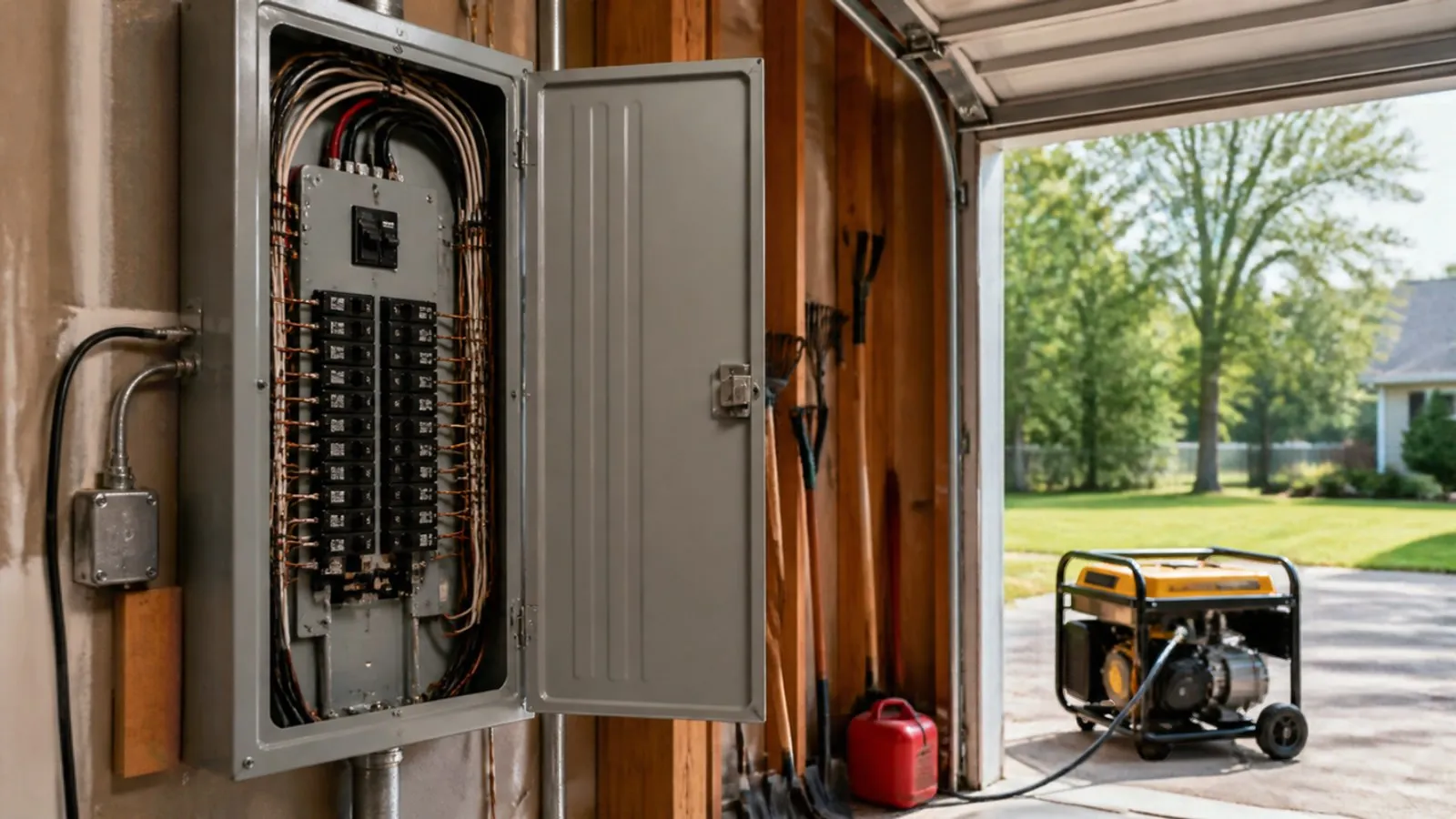
Interlock kit. Two sliding metal plates mount on the cover of your existing panel. They physically block either the main breaker or the generator breaker, so both cannot be on together. The sequence is manual: switch the main off, slide the plate, then turn the generator breaker on. You also need a power inlet on the outside of the house and a generator cord that matches your generator’s plug.
Manual transfer switch. An extra sub-panel is installed beside your main panel, with added wiring. The circuits you want to back up are moved to it when it is installed. You flip the switch from utility to generator, and only those circuits get generator power.
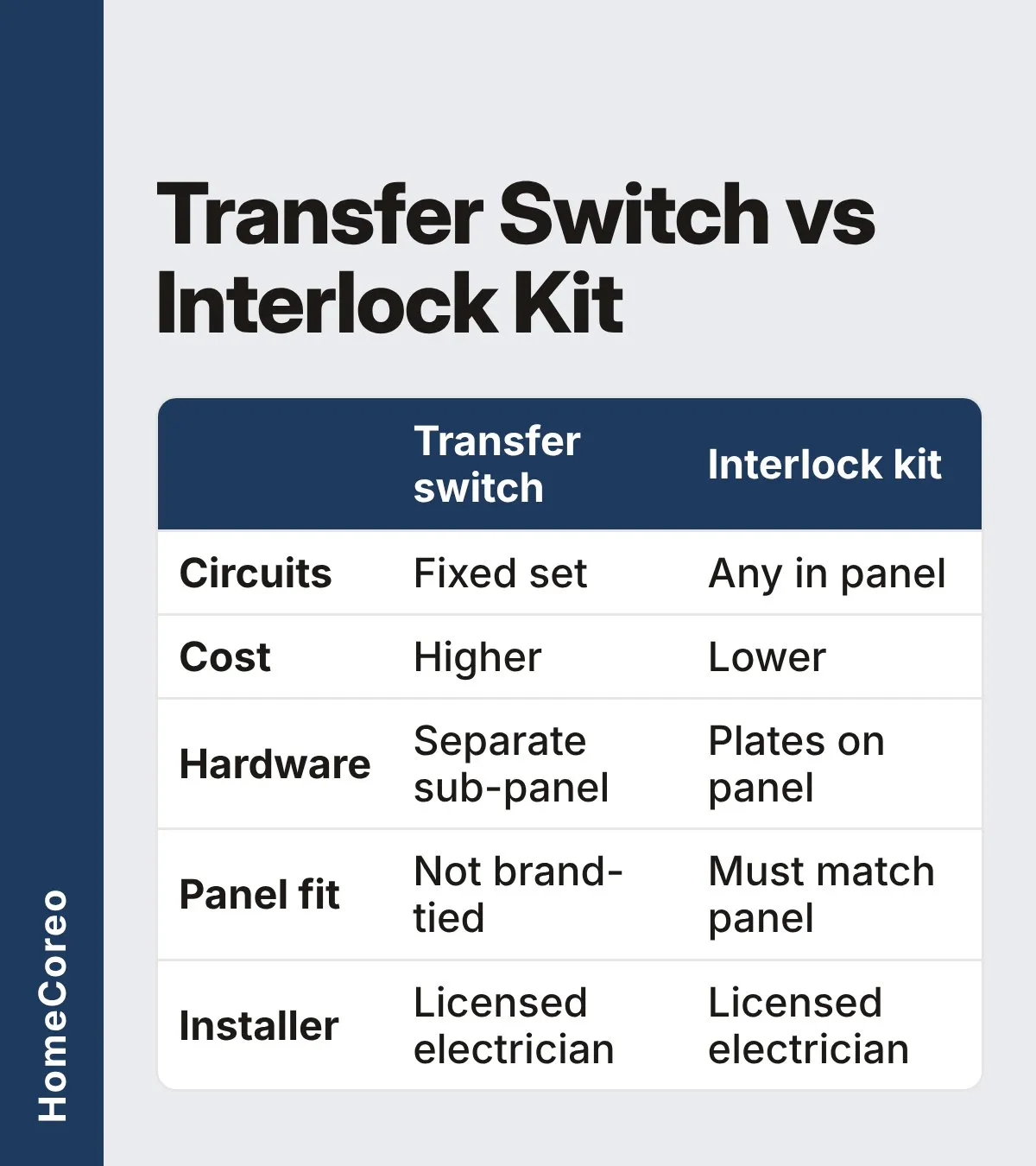
Comparison table
| Manual transfer switch | Interlock kit | |
|---|---|---|
| Circuits you can power | Only the circuits wired to the sub-panel | Any circuit in your existing panel |
| Who chooses the circuits | Set at installation | You, by switching branch breakers on or off |
| Hardware | Separate sub-panel and extra wiring | Two plates on your existing panel cover |
| Cost | Higher (materials and labor) | Noticeably lower |
| Generator match | Sized for a specific generator capacity | Works with any portable generator that fits the inlet and cord |
| Panel fit | Not tied to your panel brand | Must match panel maker, model, main breaker amps and breaker position |
| Main risk | Circuits chosen may not match what you need later | A poorly seated plate or wrong kit could allow both breakers on |
Table details come from a seller’s comparison page (see Sources), so treat it as a starting point and confirm with your electrician and local inspector.
What you need to decide
1. How many circuits do you really need?
List what must run: refrigerator, freezer, furnace blower, a well pump, some lights, a phone charger. If the list is short, a transfer switch with a few dedicated circuits is simple and predictable. If you want to switch things around during a long outage, an interlock lets you use any circuit, as long as the generator can cover it.
To avoid overloading, add up the running watts and the starting surge of the biggest motor first. The steps are in how to size a generator for your home.
2. Does a listed interlock kit exist for your panel?
Interlock kits are not universal. You need one made for your panel brand and model, matched to the main breaker’s amp rating and whether the main breaker sits on the left or right. If no kit is made for your panel, a transfer switch is the practical answer.
3. What will your local inspector accept?
Some areas want a listed product for the permit to pass, and some may have extra rules. Ask the authority having jurisdiction (AHJ), which is usually your local building or electrical department. In the UK and Australia, wiring rules differ from the NEC, and a registered electrician will know which connection method is allowed for your supply.
4. How will you operate it under stress?
An outage at night is a bad time to learn a procedure. Whichever you choose, ask the electrician to label the panel and write the switching order on a card kept near it. With an interlock the order matters: main off first, then the generator breaker.
Step by step: how to get either one installed safely
- Write down the circuits and appliances you must keep running.
- Check the generator’s running watts, starting watts and plug type.
- Photograph your panel label, noting its brand, model and main breaker amp rating.
- Call two or three licensed electricians and ask which option they would use for your panel and why.
- Ask whether a permit and inspection are required, and have the electrician arrange them.
- Have the inlet installed outdoors, then test the system under supervision before a real outage.
- Store the generator outdoors in use, well away from windows, doors and vents.
Questions to ask the electrician
- Is the interlock kit or transfer switch listed for my exact panel, and will it pass inspection here?
- Which circuits do you recommend, and why those?
- Where will the inlet go, and how far is that from windows, doors and vents?
- Will you label the panel and show me the switching order, with the generator running under a real load?
- What happens to the system if I replace the panel or the generator later?
Good answers are specific to your panel and your generator. Vague answers, or a suggestion to skip the permit, are a reason to get another quote.
Common mistakes
- Backfeeding through a wall outlet. A cord with two male plugs (“suicide cord”) is dangerous and should never be used.
- Buying the wrong interlock kit. A close match is not a match; a kit that does not seat correctly may not block both breakers.
- Overloading the generator. With an interlock, every circuit is available, so you must switch off the loads you do not need.
- Running the generator indoors or in the garage. Carbon monoxide can build up even with doors open. Keep the generator outside and pointed away from the house.
- Skipping the permit. An unpermitted hookup can cause trouble with inspections, insurance and resale.
When to call a professional
Always. Both options involve opening the main panel, which stays live from the utility side even when the main breaker is off. Hire a licensed electrician for the inlet, the kit or switch, and the permit. Call the utility if you suspect backfeed or are unsure how the hookup is set up.
Sources
 Save
Frequently asked questions
Is an interlock kit as safe as a transfer switch?
Both are accepted ways to keep utility power and generator power from being connected at the same time, but only when they are correctly matched to your panel and installed to local code. Your local inspector (the authority having jurisdiction) decides what is allowed.
Can I install either one myself?
Both involve work inside your main electrical panel, so hire a licensed electrician and pull any permit your area requires. Mistakes can energize utility lines and injure line workers.
Will an interlock kit fit any panel?
No. Kits are made for a specific panel manufacturer, model, main breaker amp rating and main breaker position. Check all four before buying.
Can I just plug the generator into a wall outlet?
No. That backfeeds the house wiring and the utility lines, and it is a serious shock and fire hazard. Use an approved inlet with a transfer switch or interlock instead.